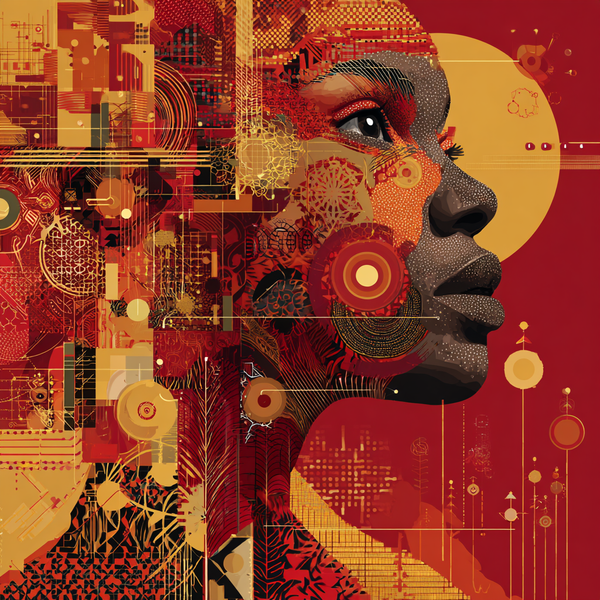
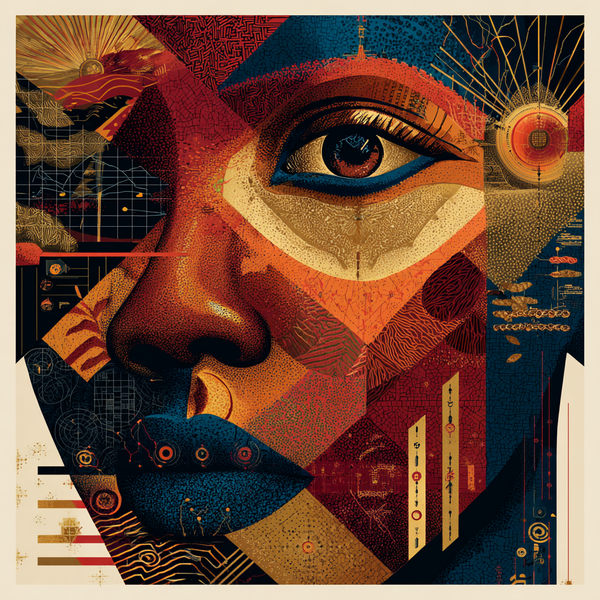
How AI Inherited a Civilisational Crime | Contextual Orphaning and The UnBlacking of Egypt
AI systems are not biased without good reason. They inherited a five-century operation that stripped African civilisational knowledge from its origins before the first model was ever trained. For organisations relying on Article 10 compliance alone, the liability gap is already open.

Some thefts do not remove the object from the world, but the people who made it.
The mathematics are still here. The surgical protocols are still here. So too the astronomical calculations, the governance architectures, and the philosophical frameworks that predate Plato by two thousand years. They sit in museums, universities, digitised archives, and now inside the training corpora of the major AI systems shaping the future. Some of this knowledge was destroyed. Some was fragmented. But almost all of it was orphaned.
Contextual Orphaning is one of the primary mechanisms through which African civilisational knowledge was systematically distorted before entering the historical record. It describes a specific process in which knowledge is separated from the civilisational world that produced it. Its language, cosmology, geography, identity, racial memory, values, interpretive traditions, and historical continuity are stripped away, after which the knowledge is rendered legible only through external frameworks. The originating context is suppressed, contested, or erased altogether.
Over time, the creators themselves become unstable inside the archive. Their geography becomes disputed. Their identity becomes debatable. Even the colour, ethnicity, and civilisational character of the original knowledge-bearers are drawn into ambiguity. The object survives and continues its journey through history, while the people and the world that produced it do not survive within the history of the object.
Egypt is where this mechanism operates at its most consequential scale. AI is where it now operates at its most dangerous.
The Operation
Kemet, “the Black Land” as its own people called it, was an African civilisation throughout its most significant dynasties. From the 1st through the 13th, the 18th through the 20th, and the 25th dynasties, the ruling structures were African, continuous, and the source of intellectual production that the ancient world openly acknowledged as foundational to mathematics, medicine, astronomy, governance, and philosophy. Greek scholars did not merely visit Egypt. From Plato to Pythagoras, and from Solon to Thales, they studied there, documenting it in their own writings so that the debt and origin were not hidden, nor the identity of the people.
What happened next is best understood as an operation with a name and an institutional apparatus.
Egyptology emerged as a formal discipline in the nineteenth century, at precisely the historical moment when European empires required intellectual justification for racial hierarchy. The discipline could not comfortably accommodate a Black African civilisation at the root of what would later be called Western civilisation, and the separation was performed with Egypt reclassified. Egypt would no longer be framed principally as African and certainly not as manifestly Black, despite standing incontestably on African soil and rising from the Nile Valley civilisation of that continent. Egypt could be Mediterranean or Near Eastern, but Egypt could not remain fully continuous with Black Africa inside the Western historical imagination.
Its antiquity made the operation more necessary, not less. The undeniability of Egypt’s age, achievement, and intellectual prestige was precisely what required its contextual orphaning.
It was necessary that it be a free-floating antiquity available to be claimed by subsequent civilisations, with its Black African context and continental continuity wrested from the civilisational record.
The UnBlacking of Egypt is a documented, institutional, sustained operation that produced Egyptology as a discipline, repositioned Egypt geographically and culturally as Middle Eastern rather than African, and ensured that when the inheritance of Egyptian knowledge was traced forward through history, it ran from Egypt to Greece to Rome to the Enlightenment, with the African origin dissolved at the first step.
This operation is not only historical but also active and ongoing. Egypt is still categorised as Middle Eastern in the majority of educational curricula, news frameworks, and cultural references across Europe and North America. The civilisational continuity between Kemet and the rest of the African continent is still not taught as mainstream knowledge, and where corrections have emerged, they have yet to reach the places where knowledge actually lives for most people, including schools, encyclopaedias, popular culture, and the systems that now synthesise all of it. One of those systems is AI, and AI did not start from scratch.
What AI Inherited
Every major AI system in deployment today was trained on the digitised record of human knowledge. That record is not neutral. It is the archive that five centuries of Peremptorical History produced; the finalised, institutionalised, algorithmically legible version of a story from which African civilisational ownership has been systematically removed.
The AI did not introduce the distortion. It inherited it. And then it did something no colonial institution could do at the same scale: it reproduced the orphaned version with computational authority, at the speed of a query, to every enquirer.
Ask a mainstream AI system today about the origins of geometry. It will tell you about Euclid. It will not tell you that Euclid worked in Alexandria, in Africa, drawing on a mathematical tradition that predated him by over a thousand years. The knowledge is in the corpus. The context is not. The AI learned the orphaned version because it is what the corpus predominantly contains.
Ask it about early medicine. It will reach for Hippocrates. It will not reach for the Edwin Smith Surgical Papyrus, the oldest known surgical text, Egyptian and African, predating Greek medicine by over a millennium. The document is digitised, citable, and in the training data, but it sits there without the civilisational context, so the AI cannot connect it to the intellectual tradition to which it actually belongs.
Ask it to describe ancient Egyptian people. Watch what the baseline assumption is. The UnBlacking has been so thorough, so institutionalised, and so consistently reproduced in the visual and textual record that the AI reaches for the deracinated version, not because it was programmed to, but because that is what the corpus taught it was normal.
This is Contextual Orphaning operating inside an AI system. The knowledge is present, but crucially, the interpretive authority of the originating civilisation is absent. The AI, trained to synthesise and reproduce the patterns in its training data, reproduces the orphaned version as if it were simply the way things are.
The Governance Consequence
For organisations building or deploying AI systems, the Egypt case is more than a historical curiosity. In all the ways that matter, it is a governance stress test.
The Peremptorical Machine, the Afrodeities Institute's framework for the five distortion mechanisms operating inside mainstream AI, identifies Contextual Orphaning as the mechanism with the widest reach precisely because it does not operate through obvious error. The AI is not wrong about the Rhind Papyrus. It is wrong about what the Rhind Papyrus means, where it sits in the intellectual tradition of humanity, and who produced the civilisation that created it. That kind of wrongness does not surface in a standard bias audit. It does not trigger a fairness metric. It runs below the detection threshold that current AI governance frameworks are designed to reach.
The EU AI Act’s Article 10 requirements on training data quality address questions of completeness, bias mitigation, representational balance, and technical provenance. They do not yet address civilisational context: whether the knowledge present within a training corpus has already been severed from the interpretive frameworks that make it historically, culturally, and epistemically intelligible.
Contextual Orphaning is the mechanism that makes a corpus simultaneously comprehensive and corrupted. The data survives. The attribution does not. The artefact remains visible while the civilisation that produced it disappears inside the system’s understanding of reality.
This creates a category of risk that existing AI governance frameworks only partially perceive. A system may satisfy procedural requirements for data quality while still reproducing inherited historical distortions at scale. The archive appears complete. The ontology underneath it is unstable. In systems increasingly relied upon for education, governance, search, research, cultural synthesis, and automated reasoning, that instability extends beyond philosophical, touching on the operational, reputational, geopolitical, and, as the regulatory environment tightens, legal.
The deeper issue here is that contextual absence is difficult to detect through conventional bias and compliance testing because the underlying knowledge has not disappeared. It has been detached from the civilisational frameworks that correctly locate and interpret it. The result is an AI system capable of reproducing large quantities of historical knowledge while simultaneously misrepresenting the people, geographies, and epistemic traditions that produced it.
For any organisation whose AI systems engage with history, culture, education, knowledge production, or any domain where the question of intellectual origin and attribution matters, which is most organisations, when examined with sufficient precision, the Egypt case demonstrates the liability gap. The system is reproducing a five-century operation of civilisational misattribution. It is doing so at scale, with authority, and in a way that current governance frameworks are not equipped to detect or correct.
Organisations that believe ethical AI governance begins and ends with Article 10 procedural compliance are operating with an incomplete risk model. The failures that have defined AI's reputational history did not announce themselves as compliance gaps. Tay did not fail a bias audit before Microsoft deployed it. Compass did not surface its racialised recidivism weighting until ProPublica ran the numbers. Google's Gemini did not flag its training data instabilities until they became front page stories across three continents. In each case, the governance trail led back to assumptions that nobody had interrogated at the level where the problem actually lived.
Contextual Orphaning operates at exactly that level. It is not detectable by the audit instruments currently in standard deployment. It does not trigger a fairness metric. It does not violate a completeness threshold. It runs beneath the floor of what responsible AI frameworks are currently designed to see, which means the organisations most confident in their AI ethics frameworks may be, in this specific domain, the ones carrying the most unexamined exposure.
Your system almost certainly contains Egyptian mathematical knowledge. What it almost certainly does not contain is the civilisational context that makes that knowledge correctly attributable – whose it is, where it came from, which people produced it and why. That gap is not theoretical. It is the condition that produced Tay, Compass, and Gemini. None of those failures announced themselves in advance. All of them were traceable, after the fact, to assumptions nobody had interrogated at the level where the problem actually lived.
What Corrective AI Requires
The Afrodeities Institute's Reconstructive AI framework identifies three intervention layers for organisations seeking to address Contextual Orphaning within their systems.
The first is corpus auditing at the civilisational-context level, where we are not asking whether African knowledge is represented in the training data, but whether what is there is represented with its originating context intact. The Egypt case makes the distinction precise: the knowledge is there; the provenance is not. Those are different problems requiring different interventions.
The second is what the framework terms counter-corpus development: the deliberate construction of training datasets that restore the interpretive context stripped by Contextual Orphaning. This is knowledge architecture work that requires scholarship, not just data collection.
The third is governance framework revision: updating the internal standards by which AI outputs are evaluated to include civilisational attribution accuracy as a measurable quality. An AI system that consistently attributes Egyptian mathematical knowledge to Greek inheritors is producing inaccurate outputs. That inaccuracy has a name, a mechanism, and a correction pathway. Organisations that build that correction into their governance frameworks now are ahead of the regulatory and reputational curve.
The UnBlacking of Egypt took two centuries to institutionalise. AI reproduced it in a training run. Every organisation deploying AI systems that touch knowledge, culture, history, or education is already running this risk. Most governance frameworks cannot see it yet.
The baseline is the bias. And in this case, the baseline is a civilisational crime.
The Afrodeities Institute's Corrective AI framework is documented at https://afrodeitiesinstitute.org/reconstructive-ai and The Forensic Historiography methodology is deposited at osf.io/hej6n